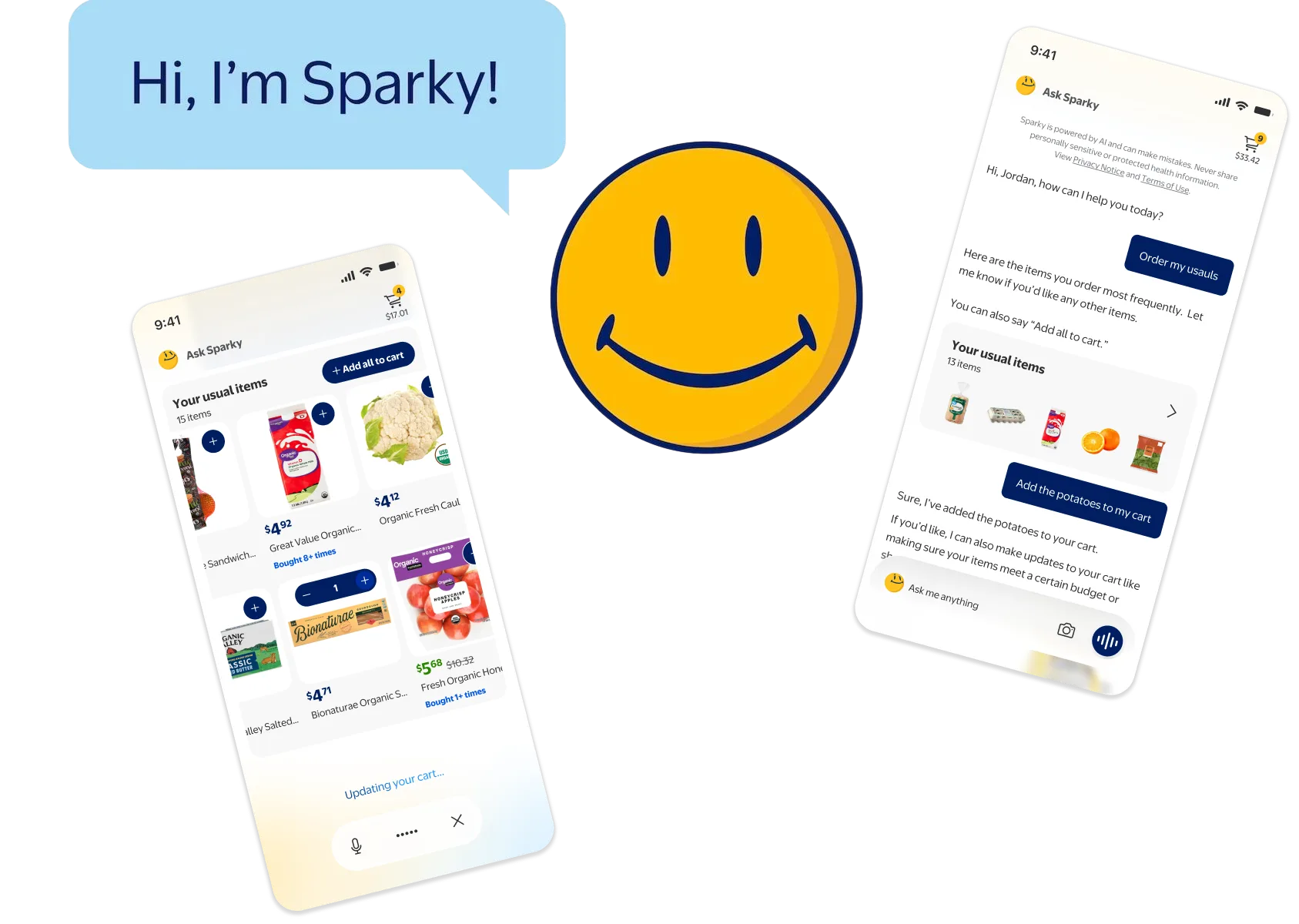
Walmart's Sparky
LiveI led product for Sparky, Walmart's customer-facing AI shopping assistant, shaping how millions of shoppers ask for help, discover products, and get things done in natural language. My remit spanned the full arc of a conversational product: from understanding what customers actually needed (grounded in conversation data at scale), to defining how the assistant should reason, respond, and eventually speak, to orchestrating the dozens of engineering, design, data-science, legal, marketing, and vendor partners required to ship it.
PRODUCT STRATEGY GROUNDED IN REAL CUSTOMER DATA
My most consequential work was reframing the product's direction with evidence. I analyzed 39.9 million conversation turns over a 90-day window to pinpoint where and why Sparky was letting customers down. The finding overturned the prevailing roadmap assumption: the assistant's failures weren't mainly about coherence or memory (independent evaluations showed coherence already scoring 87 to 91%), they were about capability. Customers didn't want better answers; they wanted Sparky to do things. Hundreds of thousands of shoppers asked “where is my order” and got a link instead of an action.
On that basis I recommended re-centering investment from “conversational quality” toward agentic commerce, enabling Sparky to take actions (track orders, manage carts, reach care) rather than only respond. It's a clear example of how I like to work: let large-scale behavioral data, not opinion, decide where the product goes next.
DEFINING HOW THE ASSISTANT THINKS AND SOUNDS
I owned the product definition for Sparky's conversational intelligence, writing the PRDs for context handling, coherence, clarification and recovery, and tone of voice, and translating fuzzy quality goals into testable behavior. To keep this honest, I built benchmarking against Walmart's sibling assistant (Rufus) using a curated set of “golden questions,” and partnered weekly with engineering to move definitions into the agent stack. The throughline was making a brand's voice feel consistent, capable, and trustworthy in every turn of a conversation.
BRINGING VOICE AND MULTIMODAL INTERACTION TO LIFE
As the assistant expanded beyond text, I led the product exploration for voice and image interaction, authoring the foundational PRDs and prototyping the experience in both interactive HTML and Figma so partners could feel the product, not just read about it. On the build-vs-buy question I ran a structured vendor evaluation: I assessed nine voice providers, narrowed to a final two, and authored a 15+ page POC framework with a weighted scoring model spanning voice quality, latency, conversational fit, and engineering integration, paired with architecture diagrams and a cost analysis to give leadership a decision-ready recommendation. I also drove the legal and brand workstreams this surfaced, including a synthetic-voice vs. digital-replica analysis with Legal and alignment with Marketing on brand voice.
CONNECTING THE DOTS ACROSS THE ORGANIZATION
Conversational products live or die on coordination, and much of my impact was in the seams between teams. I drove alignment across engineering, design, data science, legal, marketing, partnerships, and external vendors, running vendor RFPs, establishing standup and review cadences, mapping cross-team dependencies, and writing the alignment communications that got executives and ICs pointing the same direction. I also owned Sparky's integration with Customer Care, connecting the assistant to the human support systems behind it. When priorities shifted (platform re-scoping, leadership direction changes, external legal timelines), I focused on surfacing risks early and keeping the work moving.
FOCUS AREAS
MORE WORK